Beneath the surface: how human-led ESG and AI can transform Australian SMEs
By Geoff Gourley · 10/23/2026
For an Australian business owner, a difficult week can look like overdue invoices, another staff vacancy, a missed opportunity and a growing pile of administration. Somewhere in between, you are expected to find time for strategy, sustainability and artificial intelligence.
It is understandable that transformation keeps slipping down the list. When customers need answers and wages need paying, the immediate demands win.
Research from Council of Small Business Organisations Australia (COSBOA) and Commonwealth Bank reflects that pressure, identifying rising costs, workforce challenges, regulatory complexity and the personal toll on small business owners.
My view is that meaningful transformation starts by understanding what keeps producing those pressures inside the organisation.
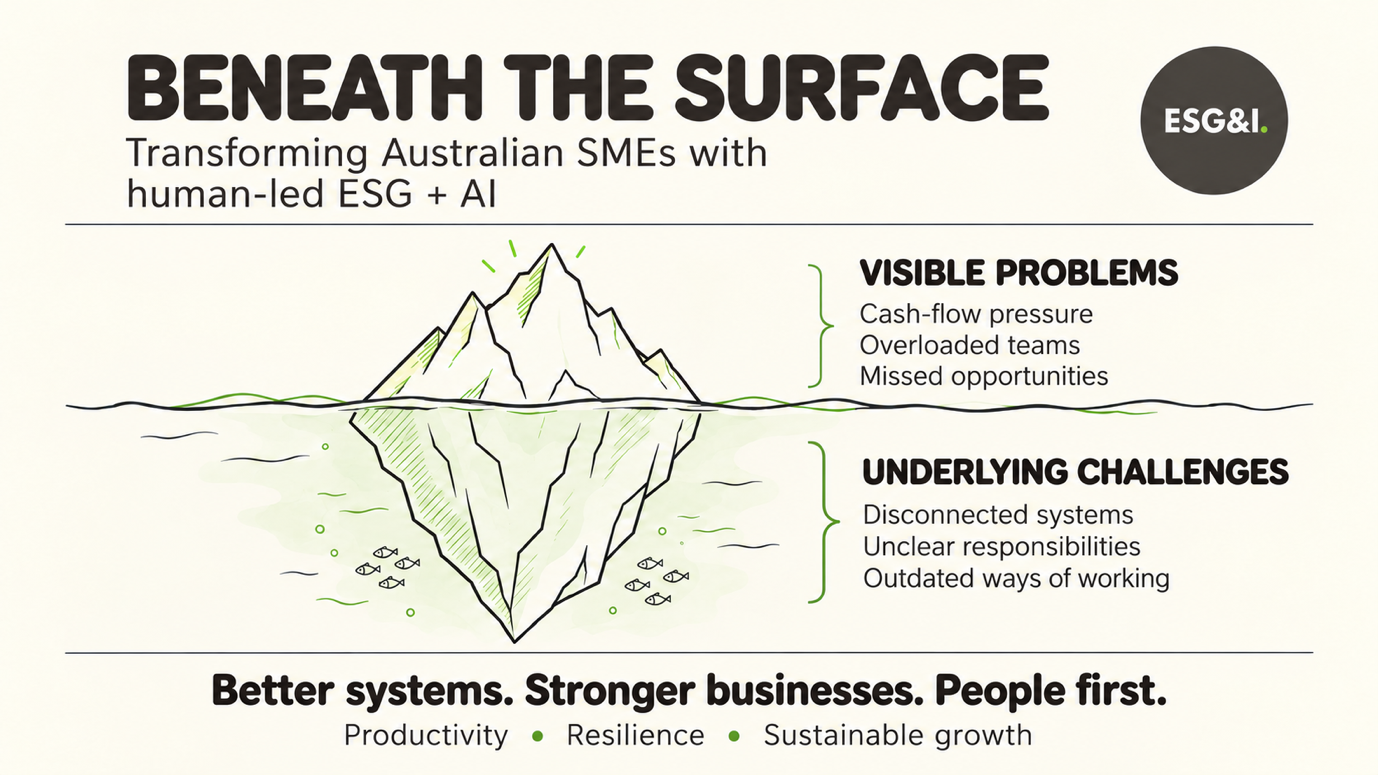
An iceberg provides a useful way to think about this. The problems we see above the waterline are only part of the story. Below them sit recurring patterns, business structures and deeply held assumptions about how work should happen.
That is where I believe environmental, social and governance practices—ESG—and AI can work together to create lasting value, with people leading the change.
Looking beneath the visible problem
Consider a business that regularly sends invoices late.
The immediate response might be to chase the accounts team. Look deeper and you may find that project completion is recorded in one system, client approval sits in someone’s inbox, and invoicing depends on the founder remembering to connect the two.
The visible problem is late invoicing. The underlying challenge is how information, responsibility and decisions move through the business.
The same thinking applies elsewhere.
A missed tender might expose gaps in evidence about workforce practices, environmental performance or supplier management. Staff turnover might reflect unclear roles, excessive administration and limited development opportunities. Slow customer responses might reveal fragmented information and too many approvals.
Solving the immediate issue matters. Understanding why it keeps returning creates the opportunity for lasting improvement.
The challenges are connected
For SMEs, financial pressure, people pressure and operational pressure often reinforce each other.
Tight margins limit investment in training. Limited training leaves people struggling with disconnected systems. Those systems create rework and delays. Delays affect customer experience and cash flow, putting margins under even more pressure.
Owners can become the approval point, knowledge repository and emergency response team for the entire organisation.
Meanwhile, opportunities to improve energy efficiency, strengthen supplier relationships or develop new services remain unexplored because nobody has the capacity to pursue them.
A transformation strategy needs to recognise these connections. Otherwise, businesses risk buying another tool while leaving the underlying workflow untouched.
ESG brings a broader view of business performance
I see ESG as a practical way to examine how a business uses resources, supports people and makes decisions.
The environmental lens asks where energy, materials and waste are creating unnecessary costs or exposure.
The social lens examines employee wellbeing, capability, inclusion, customer relationships and the treatment of people throughout the supply chain.
The governance lens looks at accountability, decision-making, information quality and whether commitments can be supported by evidence.
For an SME, this can translate into straightforward actions: understanding resource consumption, improving onboarding, setting clear responsibilities, checking suppliers and maintaining reliable business records.
The right approach should be proportionate to the organisation’s size, sector and priorities. It should help people run the business better.
AI can help turn that understanding into action
AI can support the work involved in interpreting documents, organising knowledge, preparing first drafts and identifying patterns for people to investigate.
For example, an organisation could use AI to help summarise supplier documents, prepare a customer response using approved information, or assemble an initial tender response from verified business records.
Combined with well-designed systems and ordinary automation, this can reduce repetitive effort and make useful information easier to access.
But the foundations matter. The Australian Government’s AI ecosystem report identifies implementation challenges including weak governance, immature digital infrastructure, unclear human–AI roles and poorly selected use cases.
My approach is to start with the workflow: remove unnecessary steps, simplify what remains, improve the information and then decide where automation or AI will add value.
An AI-native organisation deliberately designs how people, information and technology work together. Every step still needs a clear purpose.
Human-led needs to mean something practical
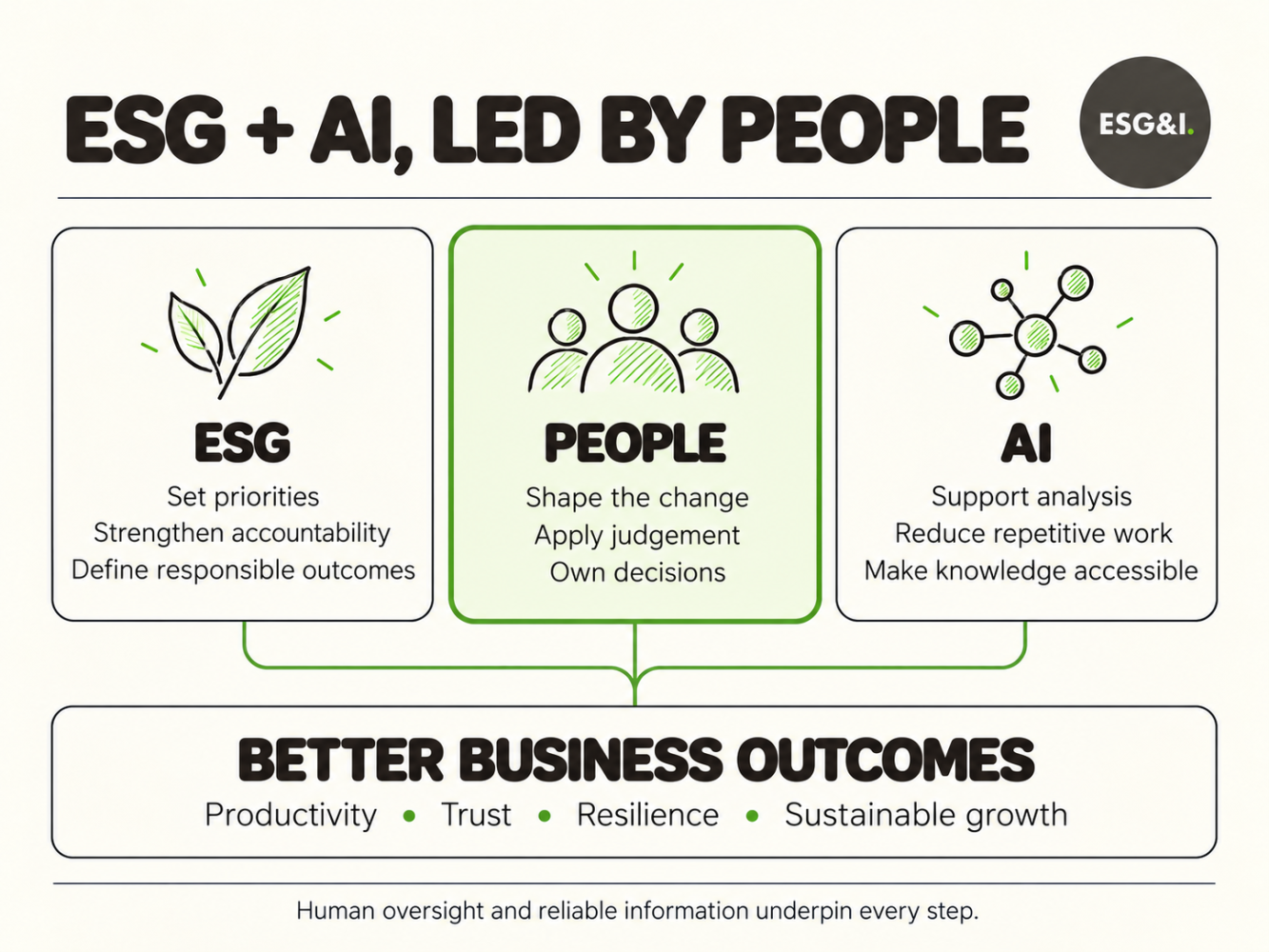
People should help define the challenge, design the solution and assess whether it works.
The employees doing the work usually know where the friction sits. Involving them early can reveal issues that a technology demonstration will never uncover.
Human-led transformation also means being clear about responsibility. Who checks an AI-generated answer? Who approves a supplier decision? Who handles an exception? When does a customer need a person?
Staff need time and support to build confidence. They also need clear boundaries around sensitive information, acceptable uses and checking outputs.
AI can produce convincing errors. Environmental and social claims still need evidence. Decisions affecting people require appropriate judgement and accountability.
These considerations belong in the design from the beginning.
What benefits can this create? 🌱
When ESG, AI and operational improvement are brought together thoughtfully, the potential benefits include:
- Higher productivity: less duplication, manual searching and repetitive administration.
- Stronger margins: better visibility of waste, rework, resource use and delivery costs.
- Improved cash-flow management: clearer project milestones, timely invoicing and more consistent follow-up.
- Better customer experiences: faster responses, smoother handovers and more reliable service.
- Greater employee capacity and wellbeing: fewer avoidable frustrations and more time for meaningful work.
- Stronger workforce capability: practical skills, accessible knowledge and clearer responsibilities.
- Improved tender readiness: organised, verified evidence of capabilities and responsible business practices.
- More informed decisions: relevant information reaching the right people at the right time.
- Better environmental performance: greater ability to identify, act on and measure resource-efficiency opportunities.
- Stronger governance and trust: clearer approvals, traceable decisions and better-supported claims.
- Greater resilience: less dependence on individual knowledge and more consistent processes.
- Capacity for sustainable growth: systems that can support more customers without multiplying administrative effort.
These outcomes need to be earned and measured. A new platform, policy or subscription does not deliver them automatically.
Start with one meaningful challenge
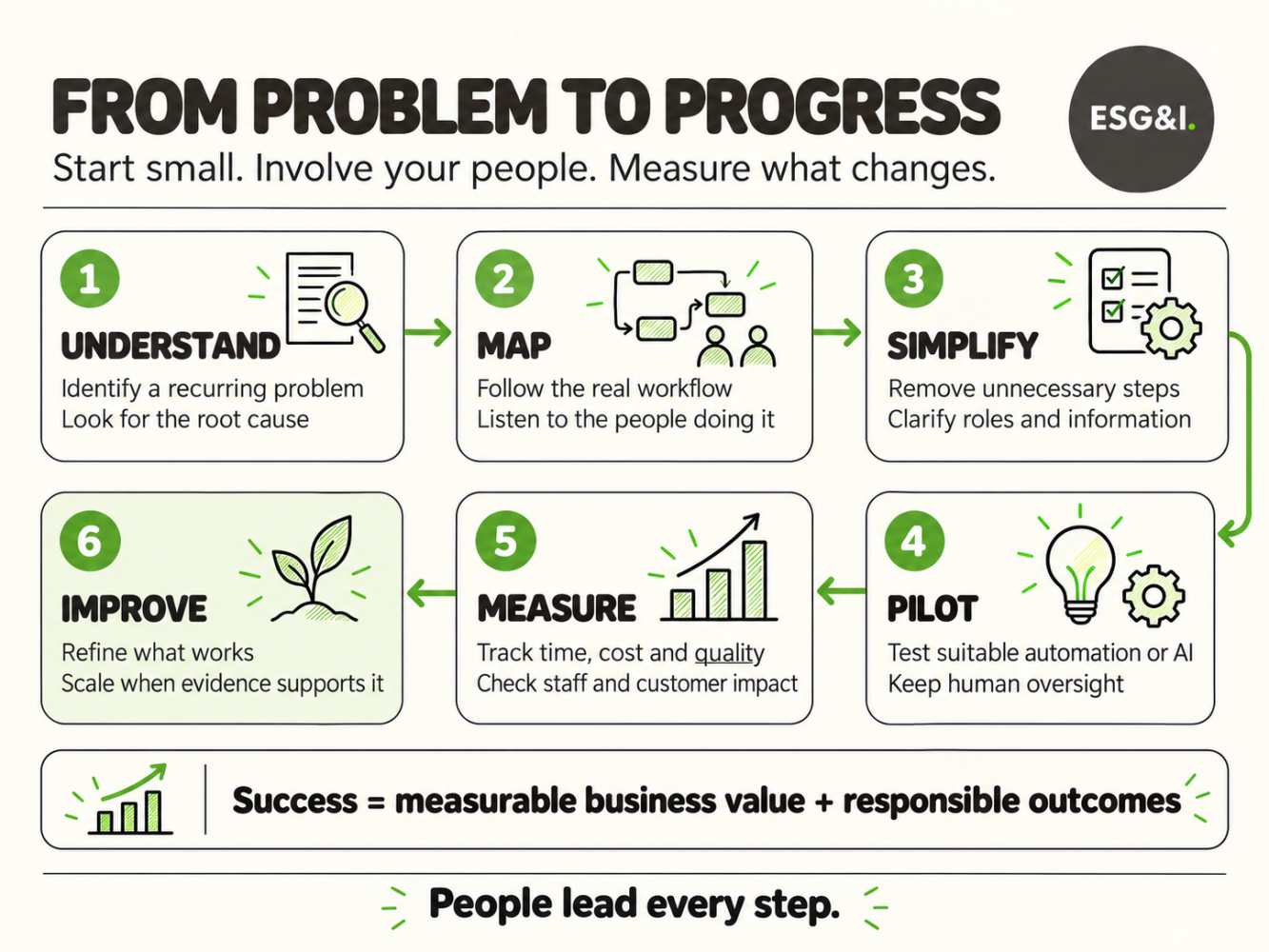
For an owner-led SME, I would begin with a workflow that matters commercially and causes regular frustration: enquiry to proposal, project completion to payment, employee onboarding or tender preparation.
Map what actually happens with the people involved. Identify delays, duplicated work, missing information and unclear decisions. Agree on the improvement you want before selecting technology.
Then run a focused pilot.
Measure the time saved, error rate, customer response time or invoicing delay. Include the cost of implementation, training, ongoing subscriptions and human review. Ask staff whether the work has become easier and more reliable.
Use that evidence to decide what to improve next.
The iceberg reminds us to look beneath the events consuming our attention. That is where we can begin changing the conditions that keep producing them.
For Australian SMEs, the opportunity is substantial: more capable teams, more responsible operations and stronger businesses, with founders gaining the space to lead.
🤝 If you are navigating these challenges, contact me. I can help you identify the underlying issues and build a practical, human-led approach to ESG, AI and business transformation that fits your organisation.
Follow Geoff Gourley for more...
About the author
Geoff Gourley is a social entrepreneur, ESG and AI advisor, and founder of ESG&I., ChatESG.au and Studio Ambira™. He helps organisations strengthen their sustainability performance, adopt AI responsibly and build more effective businesses through practical, human-led transformation.
Drawing on experience across construction, infrastructure, renewable energy, impact investment and board advisory, Geoff connects responsible business practices with innovation and commercial outcomes.
He was recognised among the Top 100 Global Social Entrepreneurs and Innovators in 2017, Top ESG Consulting Services in Australia 2025 & 2026, AI Consultant of the Year Finalist 2024 & 2025, Best Use of AI (Sustainability) 2024 Finalist, Global Top 50 ESG Thought Leaders 2025 and a Linkedin Top Voice.
To explore how ESG and AI could support your organisation, connect with Geoff on LinkedIn or visit geoffgourley.com.